CJ27ex7.3B
Repair and service
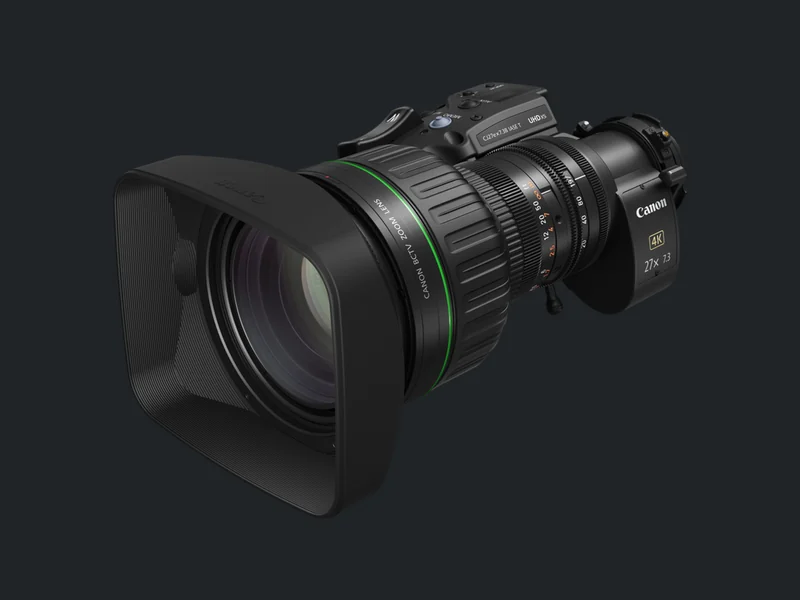
Canon CJ27ex7.3B is a 4K 2/3″ B4 lens for ENG / EFP production. 27× zoom with a 7.3–197 mm focal range before an extender is engaged.
Versions and controls
CJ27ex7.3B IASE T
For this drive configuration, we distinguish operation at the lens from commands sent by a demand or camera. Include the exact drive code, camera and controls. We check the documentation for the particular generation before specifying parts.
Find my symptom ↓Possible fault symptoms
Identify your symptom and tell us when it occurs. These are assessment topics, not a list of known recurring defects of this model.
Lens zoom not working?
The lens does not respond to a zoom command or stops before reaching the required framing.
Tell us whether zoom fails at the lens, through an external demand, or both. Check only external operating modes and connections described in the exact version’s manual. If the symptom persists, we can arrange assessment of the lens, drive and control chain. The symptom alone does not identify a part that needs replacement.
Zoom is jerky, drifts or only moves in one direction?
Zoom jumps, creeps in or out with no command, or moves in the same direction for both control inputs.
Record which control and speed reveal the symptom. Include a short video if it is safe to reproduce, and mention any programmed zoom functions in use. Do not open the demand or adjust internal potentiometers. Settings, the demand, cable and lens drive need to be distinguished before a repair is specified.
Zoom or focus demand not responding?
The controller is powered but commands do not reach the lens; operation at the lens may differ from operation at the demand.
Include the complete lens, drive, demand and cable identifiers, plus connector photographs. Connector shape or pin count alone does not establish compatibility. Focus control depends on the version and fitted accessories. Do not rewire connections or experiment with unverified adapters.
Lens loses focus when zooming?
The image is sharp at telephoto but soft at wide angle, or the other way round. Looking for back-focus adjustment?
This alone does not prove a fault: back focus may need setting for the particular camera and lens combination. Tell us the camera model, any adapter and whether the issue started after changing cameras. If adjustment following the manufacturer’s instructions will not hold, request an assessment. Do not dismantle the optical assemblies.
Back focus will not adjust or stay locked?
The setting changes after locking, there is play, or the available adjustment does not bring the image into focus.
Describe whether it repeats with the same camera and whether the lens has suffered an impact. Do not try to remove play by overtightening screws or dismantling the mount. Include both camera and lens models. Assessment determines whether setup, mounting checks or specialist optical work is appropriate.
Focus ring is stiff, rough or sticking?
The ring is hard to turn, feels uneven, makes a grinding noise or catches at a particular position.
Do not force it or apply oil or general-purpose lubricant. Describe where the resistance occurs, any long storage period and any impact history. Feel alone cannot establish that fresh grease is the solution; mechanical assessment determines the work needed.
Servo focus not responding?
The focus drive does not respond or its movement differs from the demand input.
This applies only to a servo-focus version or a correctly fitted external focus module. Supply the full drive and demand identifiers. A manual-focus version without the required module is not faulty simply because it ignores an electronic command. Once the configuration is established, we can arrange control or drive assessment.
Iris or CCU aperture control not working?
The iris does not respond, exposure changes unevenly, or aperture position data is missing at the camera.
Tell us whether manual, automatic or remote control fails, and identify the camera and CCU. Check external mode selection against the manual. Loss of CCU control alone does not prove an iris mechanism fault. If it persists, we arrange assessment of the control chain and lens; do not touch the iris blades.
Zoom mechanism is stuck or making unusual noise?
Movement stops, or there is new grinding, clicking or resistance.
Stop testing and do not force movement. Do not try to free a jam by repeatedly driving the servo. Send a photograph of the model label and describe when the problem began. Initial assessment helps route the lens to the right specialist; cleaning, lubrication or replacement parts are agreed after diagnosis.
Lens dropped, or image quality changed after an impact?
Sharpness, control or ring movement changed after an incident, even though the housing may look intact.
Stop using the lens and arrange an assessment. Describe the impact and send photographs of the exterior. Do not open the housing or try to straighten the mount. Repair feasibility, parts and a quotation depend on examination of the actual lens.
Moisture inside the lens or persistent fogging?
You can see moisture or fogging that persists after rain, storage or a temperature change.
If water ingress is suspected, switch the equipment off and do not power it up for tests. Tell us when and how the issue appeared. Do not open or heat the lens, or attempt to clean internal optical surfaces. Contact us for handling and service-intake guidance.
Do not dismantle the lens yourself.
Do not open the housing or servo drive, alter internal adjustments or apply lubricant. This can disturb optical alignment or damage precision assemblies. Never force a stuck ring. If water ingress is suspected, or there is an unusual smell, smoke or noise, switch the equipment off and contact service.
A safe first step: record the complete model code, external mode settings, camera and demand models. Inspect connectors only externally with equipment switched off; do not attempt internal contact or wiring repairs.
Request service ↗Care and inspection interval
Inspection timing depends on the exact version, its manual and operating conditions. Maintenance does not necessarily mean a complete strip-down or parts replacement. If a fault appears, do not wait for a scheduled inspection.
Store capped and protect against impact and moisture. Clean external surfaces as directed by the specific operation manual; leave internal cleaning and lubrication to service.
Maintenance source listed for this versionManufacturer documentation
Match the document to the complete lens and drive code. An operation manual or brochure is not a factory repair manual.
From symptom to an agreed repair
- 01
Enquiry
We receive the model, configuration and symptom details, then agree what to send.
- 02
Assessment and quotation
We carry out initial checks in Vilnius. Specialist diagnosis and repair are arranged through official manufacturer service laboratories. After diagnosis, we provide findings and a quotation.
- 03
Approved work
Work is ordered after your approval and payment. Repair feasibility, parts and timing are confirmed individually.
- 04
Return
The lens is returned with a service certificate recording the date, work performed and check results. You can present it to a future buyer.
Need an assessment?
Tell us the model and symptoms. We will arrange assessment and intake in Vilnius or by courier.
+370 610 04443service@lensservice.ltVilkpėdės g. 22, Vilnius · 4th floorWeekdays 09:00–16:30
Please call before visiting.